
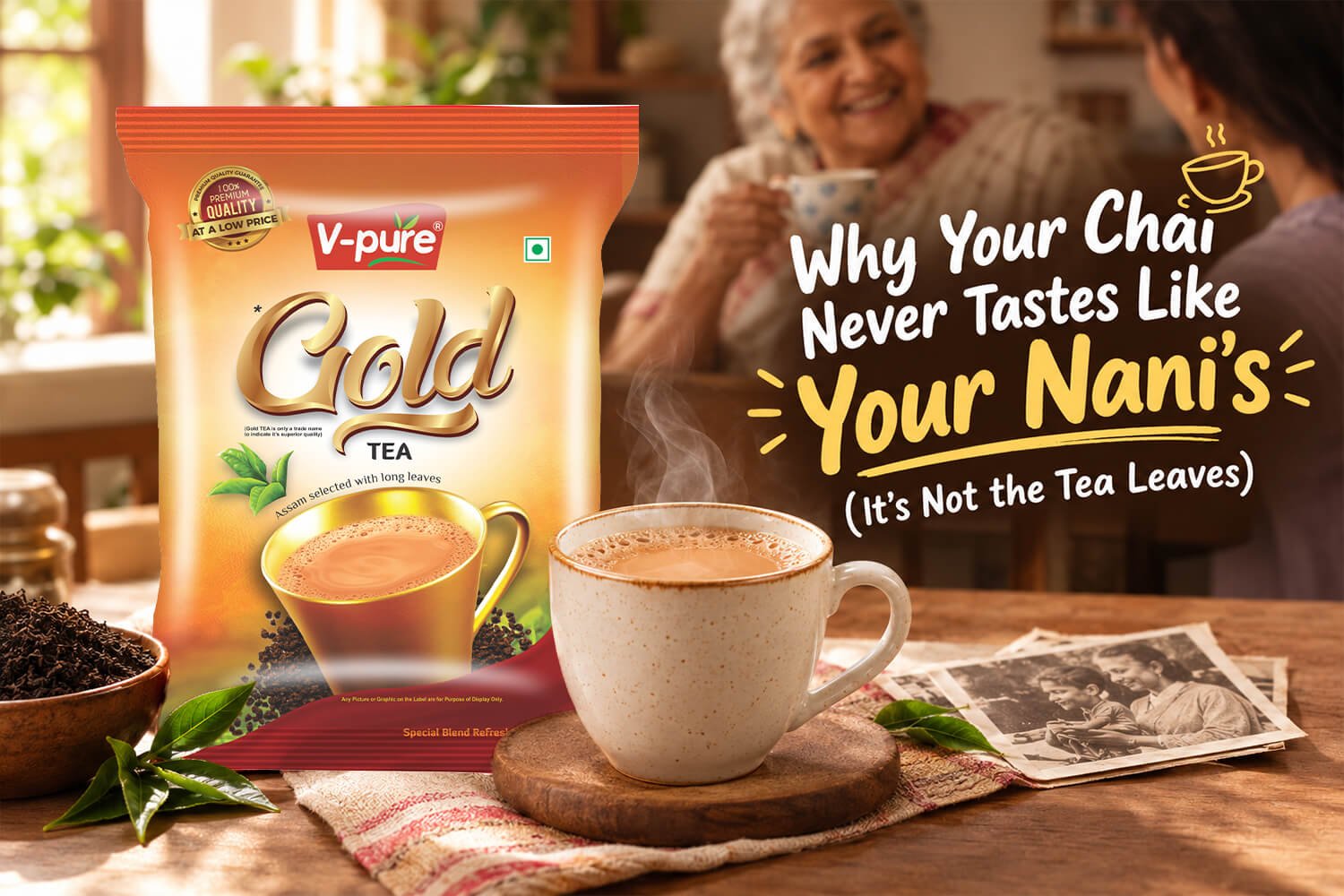
You’ve tried everything. Same brand of tea leaves she used. Same steel patila. Even the same steps — water first, then milk, then a boil, then sugar. And yet, the cup in your hand tastes… flat. Like chai’s photocopy, not the original.
Here’s the thing nobody tells you: it was never about the tea leaves.
The masala she never measured
Ask any grandmother for her chai recipe and she’ll say “bas thoda sa” — a little of this, a little of that. What she’s actually doing is layering a masala blend from memory: crushed ginger, a cardamom pod cracked (not powdered), sometimes a sliver of cinnamon, sometimes a single clove. The ratio isn’t written anywhere because it was never meant to be exact — it adjusted with the season, the mood, whoever was visiting. Store-bought chai masala gives you consistency. It rarely gives you her chai, because it’s built for the average cup, not your family’s cup.
The boil that isn’t a boil
Most people bring chai to one aggressive rolling boil and call it done. Nani’s chai got several small boils — a rise, a slight simmer-down, a rise again. That repeated agitation is what actually pulls the tannins and color out of the leaves properly, instead of just cooking the milk. Rush it, and you get pale, watery chai even with good leaves.
The water-to-milk ratio you’re probably getting wrong
Restaurant and homemade chai differ mostly here. A lot of home cooks today go heavy on milk because it feels “richer.” But traditional chai starts with water doing most of the extraction work, and milk is added to mellow it out — not replace it. Too much milk too early and the tea never gets a chance to actually brew.
The spice that’s doing the real work
If there’s one spice that separates forgettable chai from memorable chai, it’s freshly crushed ginger — not powder, not paste from a jar sitting in your fridge for three weeks. Fresh ginger, crushed just before it goes in, releases oils that ginger powder simply can’t replicate. It’s a small step that’s almost always skipped when people are in a hurry.
So what actually fixes it?
Not a fancier tea leaf. Start with your own masala — even three ingredients, freshly crushed, is more honest than a pre-mixed packet. Let the chai boil in stages, not once. Go easy on milk at the start. And always, always use ginger you crushed today, not last week.
Chai was never a recipe. It was a rhythm. Once you stop looking for the “right” tea leaf and start paying attention to that rhythm, you’ll get a lot closer to that cup you’re actually chasing.