
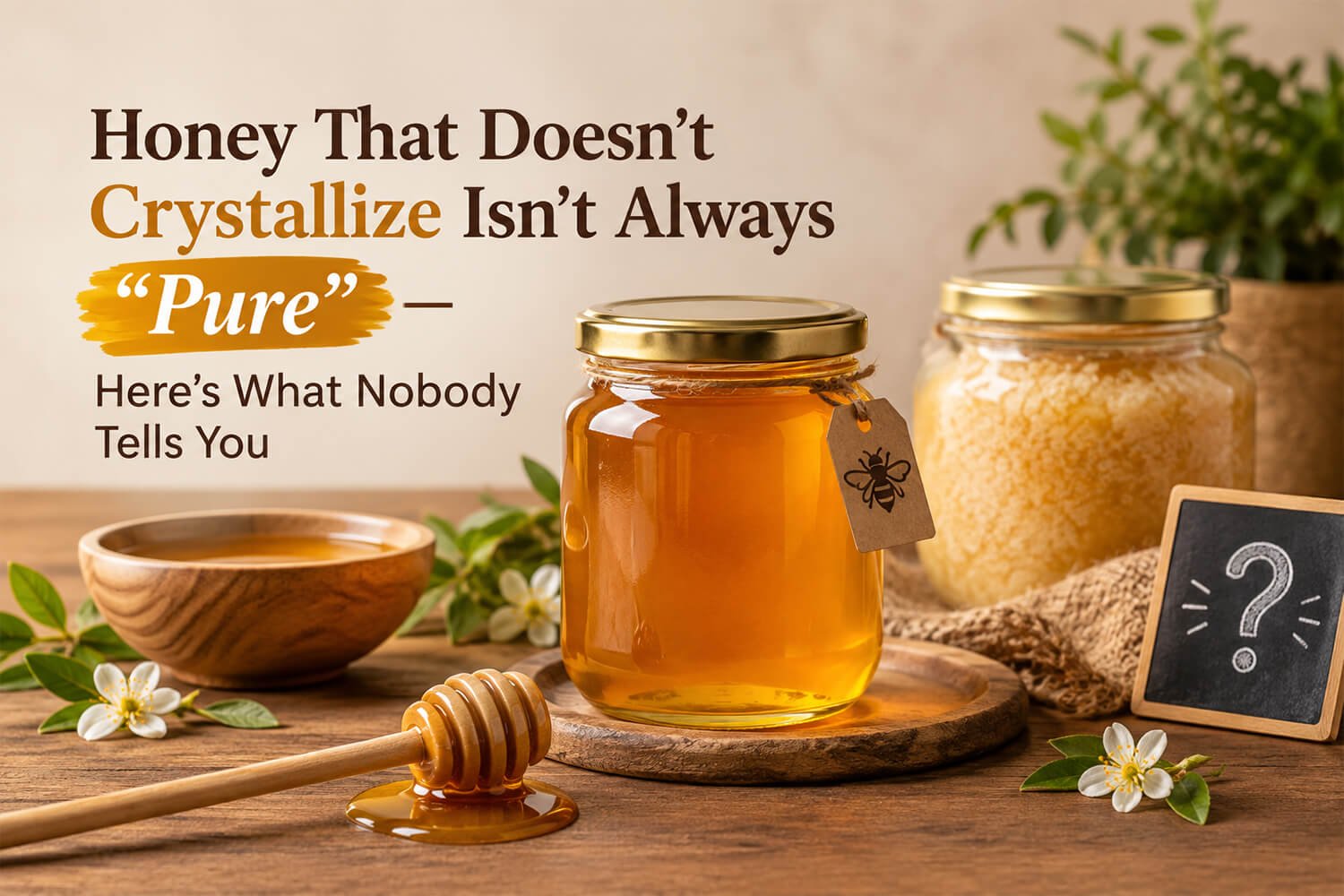
There’s a popular kitchen myth that refuses to die: if your honey turns solid and grainy in the jar, it’s fake. If it stays smooth and liquid forever, it must be “pure.”
It’s actually the opposite that’s often true — and once you understand why honey crystallizes, you’ll never judge a jar by its texture again.
Why honey crystallizes in the first place
Raw, natural honey is a supersaturated sugar solution — it holds more glucose than water can technically dissolve. Over time, that excess glucose separates out and forms crystals, especially in cooler temperatures. It’s not spoilage. It’s not contamination. It’s basic chemistry, and it happens to honest, unprocessed honey more often than to the shiny, forever-liquid stuff sitting on some supermarket shelves.
So why does some honey never crystallize?
Heavily processed honey is often heated and ultra-filtered to remove pollen, wax particles, and tiny crystals that would otherwise trigger crystallization. This gives it that clear, syrupy look that never seems to change — which, ironically, is often a sign it’s been altered more, not less. Some honey is also blended with sugar syrups that resist crystallizing the way natural honey does.
The real markers of purity have nothing to do with texture
If clarity and shelf-stability aren’t reliable signs, what actually matters?
- Source transparency — knowing which region and season the honey was harvested in
- Minimal processing — raw, unheated honey retains natural enzymes and pollen
- Natural variation — pure honey from different batches can look and taste slightly different; identical honey jar after jar is a red flag, not a good sign
- Crystallization behaviour — honey that crystallizes unevenly, with a grainy texture at the bottom of the jar first, is actually behaving the way real honey does
What to actually do when your honey crystallizes
Don’t panic, and don’t throw it away. Place the jar in a bowl of warm (not boiling) water for a few minutes and it will return to liquid form without damaging its natural properties. Repeated heating over high heat, however, does start degrading some of the beneficial enzymes — so gentle warming, only when needed, is the way to go.
The bottom line
Crystallized honey isn’t the villain of your kitchen. It’s often the more honest jar. The next time you see sugar-like grains settling at the bottom, that’s not your honey going bad — that’s just it being exactly what it claims to be.